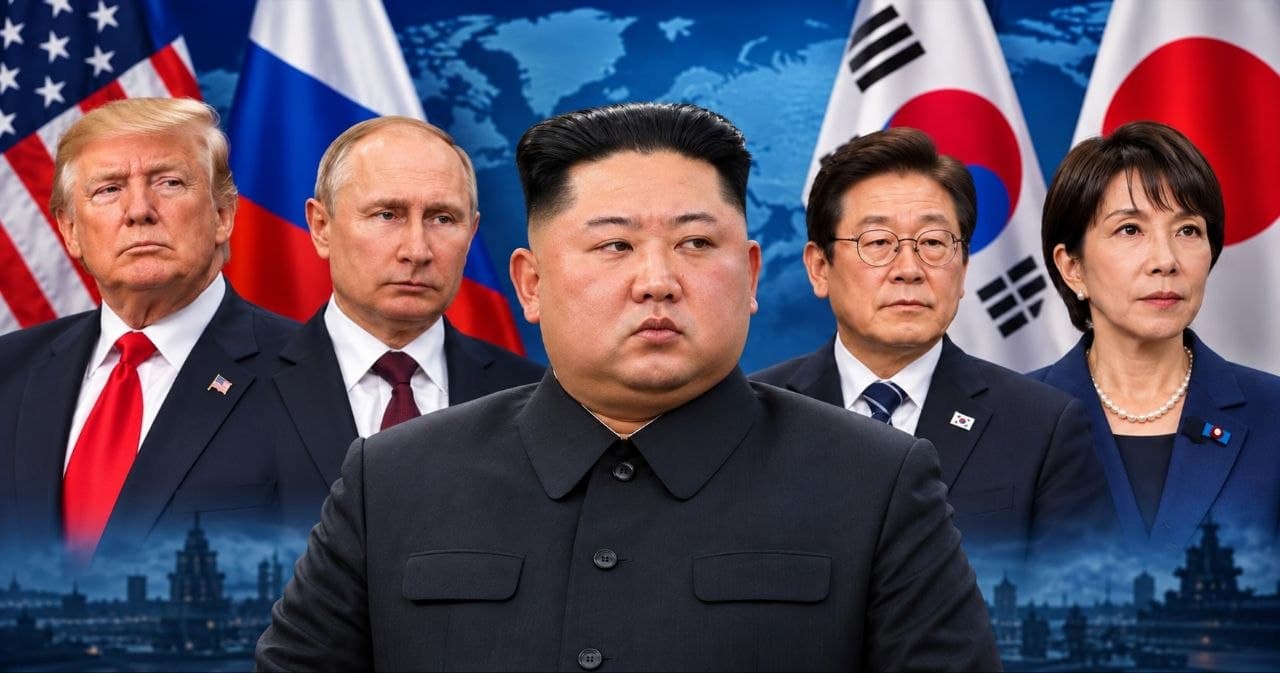
North Korean leader Kim Jong Un is perhaps one of the most sought-after leaders by other heads of state in the world. U.S. President Donald Trump wants to meet Kim during an upcoming trip to Asia in November, and similarly, South Korean President Lee Jae-myung and Japanese Prime Minister Sanae Takaichi both intend to meet him. Kim previously stood alongside Chinese President Xi Jinping and Russian President Vladimir Putin at a massive military parade in Beijing in 2025 and received an invitation to visit Russia.
All these events signify more than just an easing of diplomatic isolation. With a bridge connecting North Korea and China recently inaugurated this October, alongside a new bridge connecting to Russia opened in September, Pyongyang has deepened its economic ties with Beijing and Moscow. This could help North Korea mitigate the impact of international sanctions.
Furthermore, North Korea’s involvement in the war in Ukraine has provided Kim with new leverage that North Korean leaders never previously possessed. Multi-billion-dollar arms sales and military support to Moscow have improved North Korea’s economic situation and made Pyongyang even more strategically valuable in the eyes of Beijing. This suggests that the United States’ most important bargaining chip—sanctions relief—no longer carries as much weight as before.
Kim Jong Un currently has many reasons to breathe easy. When Trump and Xi Jinping met in Washington in September, neither leader brought up North Korea’s denuclearization. However, that remains insufficient to convince Kim that a new meeting with Trump is worth his time, especially after their 2019 summit in Vietnam ended empty-handed. While the U.S. proposal to arrange a meeting has yet to receive a response, North Korea has publicly rejected Lee Jae-myung’s call for a summit aimed at finding a formal end to the state of war between the two Koreas and stopping the expansion of Pyongyang’s nuclear arsenal. To date, North Korea also continues to ignore Takaichi’s proposal to organize a summit intended to resolve the issue of Japanese citizens abducted by North Korea.
It is not surprising that the leaders of South Korea and Japan want to meet Kim Jong Un. Facing a deteriorating security environment combined with North Korea’s advances in both conventional military capabilities and its nuclear arsenal, it has become clear that a policy of isolating North Korea is insufficient to maintain and protect peace on the Korean Peninsula. Right now, analysts view Kim as being in a position where he holds the leverage to choose which leaders he wants to meet.
According to Bloomberg, Kim’s regime earned up to $22 billion from abroad between 2022 and 2025. Shifts in the balance of power have helped Kim strengthen North Korea's international standing, transitioning it from an isolated state to a member of a coalition of anti-Western powers. According to Jenny Town, a North Korea expert at the Stimson Center, the relationships Kim has forged are gradually paying off. Put simply, Kim currently faces no pressure or compelling reasons to negotiate with the U.S. or Japan under conditions he considers unacceptable.
A difficult question arises: If the objective of talks with Kim Jong Un no longer focuses on denuclearization, what is the strategy? Here, the answer lies in re-establishing channels of communication and risk reduction as realistic motivations behind the desire to arrange meetings with North Korea. This means the nuclear issue can wait for later resolution, while the top priority is maintaining regional stability and minimizing the risk of war.
Russia's war against Ukraine has yielded benefits for North Korea that extend beyond economic gains. Tens of thousands of North Korean troops have been deployed to the battlefield to bolster Russian forces in the war with Ukraine. These troops have gained real-world experience on modern battlefields, particularly in drone warfare.
Upon returning to North Korea, they will serve as specialists instructing other North Korean soldiers in modern warfare techniques. This is helping Pyongyang modernize and upgrade its military capabilities. There is also evidence of advanced military technology transfers. In September, North Korea test-fired two types of strategic cruise missiles from a submarine and conducted multiple ballistic missile test launches into the sea.
It is worth noting that North and South Korea are currently experiencing heightened tensions following a landmine explosion in the Demilitarized Zone in September, which severely injured two South Korean soldiers.
Both Seoul and Pyongyang issued threats of retaliatory measures, with a new North Korean division deployed to border launch positions. The major fear right now is that a miscalculation or accident could trigger a border conflict between the two Koreas. North and South Korea have remained technically at war since the Korean War ended in 1953 under an armistice agreement rather than a peace treaty.
Another major challenge is that exerting pressure on Kim has become extremely difficult, and as his stance grows even firmer, it remains uncertain what, if anything, can persuade him to return to the negotiating table.